
photo by Lotus Porte-Moyel
Biographical Statement
Salomé Aydlett is a sculptural ceramicist based in Missoula, MT and received their BFA in Ceramics and BA in Spanish from The University of Montana in 2025. Originally from Winona, MN and a family of artists, Salomé grew up playing with clay. It is their first language and their child-like relationship to clay remains present in their work. Salomé’s work primarily centers on the human body and its physical connection to language.
In the rare times Salomé is not treating the studio as a hermitage, you can find them outside enjoying the sun or inside enjoying a good book.
Artist Statement
Through ceramic sculpture, I abstract the human form and other objects to create narratives where everything is replete with meaning and intentionally situated between the subjective realities of the artist and viewer. My desire to create and communicate in a way that feels both authentic to myself and open to others stems from my difficulties with verbal language. Speech has always felt like a dubious, disjointed, prescribed, and wholly inept way for me to communicate my deeper urges, insights, and questions to the world. Each word has so much variability and yet expected fixed meaning, and I struggle to find combinations that are mutually intelligible: I am intimately aware that what I say can be different from what is understood, and this unintentional abstraction of meaning often means I feel isolated in my perception of the world. This feeling in itself generates much of the content of my artwork, but paradoxically it’s through ceramic sculpture that I’m able to overcome the extremes of it. Because my feelings of separateness stem predominantly from the unintentional abstraction of meaning, when I instead abstract meaning intentionally I begin to feel more prescient about what I’m communicating.
Clay’s incredible malleability makes it the perfect material for the intentional abstraction of language. This is because verbal language sits on a fixed plane where words are defined and strung together to create universally prescribed meanings for their interlocutors, but sculptural language is much less linear and rigid. As a material, clay is incredibly plastic. This plasticity–this resistance against rigidity and definition–transmits to clay as a material language. Meaning becomes abstract simply because it more readily escapes definition within the paradigm of material languages. Put simply, there is less set expectation for what I communicate through sculpture to be the exact same thing that’s interpreted by a viewer: very little can be lost in translation when there’s no expected or exact translation to speak of–when meaning is intentionally varied the subjective understandings of both artist and viewer are inherently correct.
This is the ethos that drives my thinking about how and why I create, but beyond this truth there are central forms and representations that occur frequently in my artistic practice (it’s worth noting that I analyze and think about these components in one way, but it’s certainly not the only way they can be understood). I view my artwork as a continuous visual exploration of what it feels like to exist in spaces where the predominant mode of communication (verbal language) doesn't match with my own internal dialogue. Understanding this struggle with language is just as important as creating a space for it to comfortably exist, and in my current body of work abstracted sculptural representations of myself congregate and create an external reflection of my own internal spaces. These self-representations melt and meld together to produce abstract bodies and objects that mimic the unintentional abstraction of meaning I often feel in the verbal world, and are an amalgamation of thoughts, feelings, worries, and events given physical form without the need for verbal intervention. The vibrant, globular, spontaneous glazing of my pieces saturates the surface of my struggle with verbal language with a welcome playfulness and levity: there is something deeply conventionally humorous about being an artist who struggles to authentically express themself in any remotely standard way.
Ultimately, my artwork is an ongoing exploration and interrogation of meaning, an attempt at dismantling the internalized preeminence of verbal language, and a continuous search for more authentic forms of expression. Can meaning ever really be objective, or does it just vacillate between intentional and unintentional abstraction? What do our own internal languages look and sound like, and how do we make sure they’re welcoming for both ourselves and others? Most importantly, what resonates and feels authentic to you?
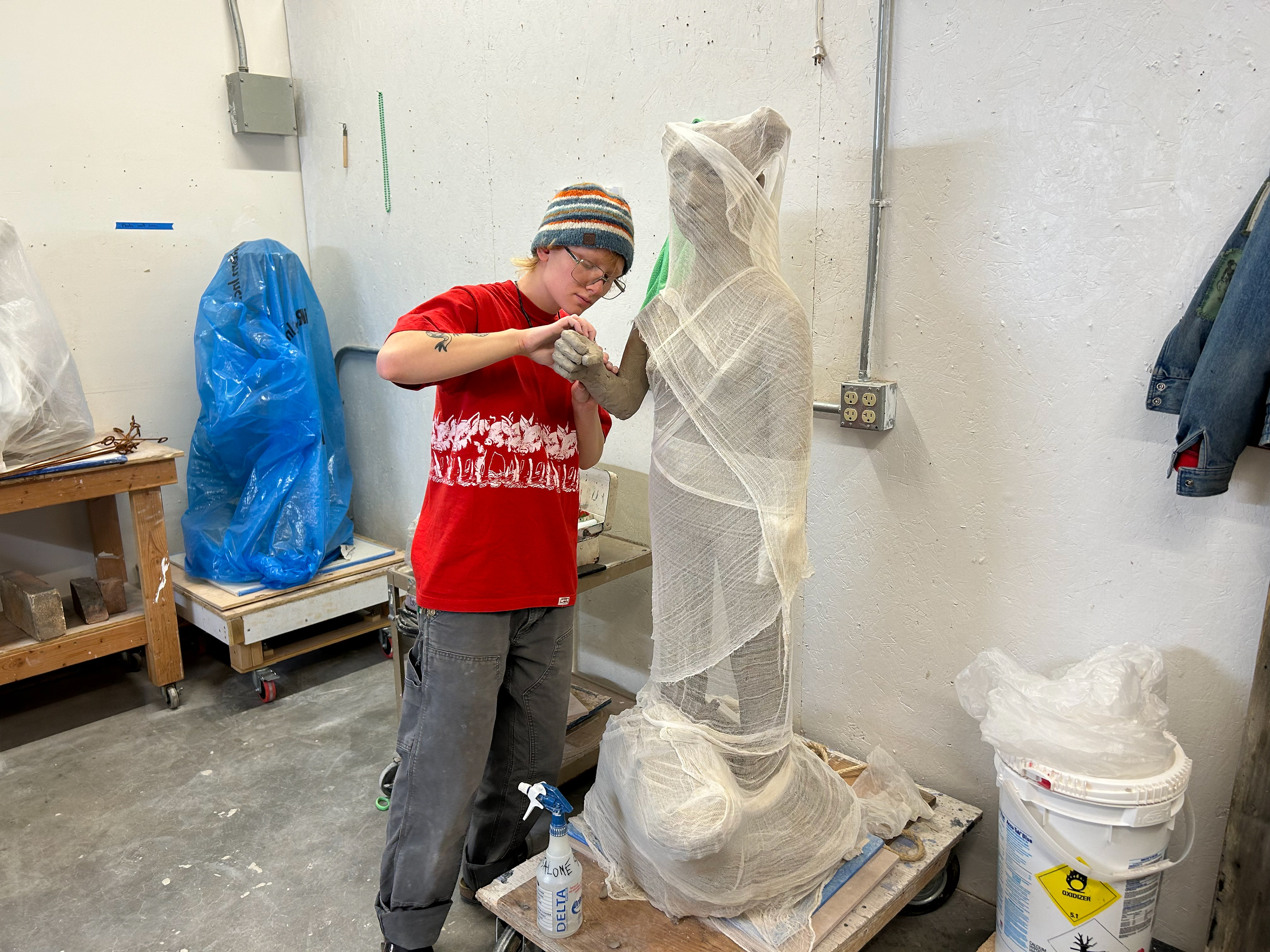
photo by Michael Hart